---
title: "RSU Playbook"
author: "Mike Sikar"
url: "https://deltafinancial.com.au/4/rsu-playbook"
---
## ⚠️The RSU Tax Trap Most Tech Execs Don’t See Coming
Last quarter, I got a call from a VP of Engineering at a US-listed tech company.
His RSUs had just vested. $200K worth.
His company withheld nothing. That’s how Australian ESS rules work the full value lands in his assessable income, taxed at his marginal rate when he lodges his return.
His marginal rate? 47% including Medicare levy.
Tax bill at year end: $94,000.
He hadn’t set aside a cent.
He’d spent the year treating his RSU income like a bonus. New car. Extension on the house. Europe trip.
The ATO didn’t care.
This happens to tech executives every single financial year.
### Are you in this situation right now?
✅ You’re a senior tech exec at Atlassian, Google, Canva, Salesforce, CrowdStrike, or similar
✅ RSUs vest quarterly — and every vest creates a tax event you’re not fully across
✅ Your household income is $400K–$1M+ excluding RSUs but you don’t feel wealthy
✅ You’re in the 47% bracket (including Medicare levy) and haven’t set aside cash for your tax bill
✅ You’ve got lazy equity sitting in your home and you know you could be doing something with it
✅ You know you should have a plan but every time you sit down to think about it, you get overwhelmed and don’t
**If you ticked 3 or more — this playbook was written for you.**
## Watch: do you have a tax problem with your employee share scheme?
## 🔍Why Most Tech Execs Handle RSUs Wrong
Not because they're not smart. You run P&Ls. You manage headcount. You've shipped products used by millions.
But RSU tax strategy in Australia sits at a very specific intersection:
- Australian ESS rules (Division 83A) — completely different from the US
- Your full vest value is added to assessable income and taxed at marginal rates up to 47%
- CGT rules — real, but often misused in ways that create concentration risk
- Division 293 — the extra 15% super tax that kicks in when your income crosses $250K
- Non concessional after tax contributions, one of the most underutilised levers available
Most advisers don't know this world. Most accountants handle it reactively, after the damage is done.
**This playbook gives you the framework. The strategy session — once you've read through — gives you the personalised plan.**
## 💡The Core Problem: You’re Not Invested. You’re Concentrated.
### The 2026 Tech Software Crash — What’s Happening Right Now
As of late March 2026, the technology software sector has lost approximately 30% of its value in just three months.
Analysts are calling it an “AI bust” — fear that generative AI will disrupt traditional software subscription models has triggered a broad, sharp sell-off.
**📉 US Software Stocks (last 12 months):**
→ Atlassian (TEAM): −70%
→ ServiceNow (NOW): −44%
→ HubSpot (HUBS): −45%
→ Salesforce (CRM): −33%
→ Adobe (ADBE): −39%
**📉 ASX Tech Stocks (2026):**
→ WiseTech Global (WTC): −53%
→ Xero (XRO): −50% in last six months
→ SiteMinder (SDR): −54%
These are not obscure small-caps. These are the companies where tech executives work, earn their salary, and hold their RSUs.
Executives who had a structured sell-down plan 12 months ago diversified out.
They’re still on track.
The ones who were ‘waiting for the right time’
or holding for the 12-month CGT discount
are reading this.
**Here’s the thing most executives don’t realise until it’s too late:**
>Your salary already depends on your employer.
>Your career progression already depends on your employer.
>Your RSUs mean your wealth also depends on your employer.
>That’s three major life inputs tied to one company.
The 2026 tech software crash is a live demonstration of exactly this risk.
WiseTech down 53%. Xero down 50%. Salesforce down 33%.
These corrections are happening right now to companies where tech executives are employed and compensated in equity.
This is **concentration risk**. And it’s the hidden threat sitting inside most tech exec portfolios right now.
## 🚨The CGT Discount Trap: When 'Smart Tax Planning' Becomes an Expensive Mistake
This is one of the most common and most costly mistakes I see Australian tech executives make.
The logic sounds sensible. Hold your RSUs for 12 months after vesting. Qualify for the 50% CGT discount on any gain above your cost base. At a 47% marginal rate, that's a real tax saving.
And from 1 July 2027, the rules change.
### 🗓️ What changes on 1 July 2027
The 2026 Budget is now law. It replaces the 50% CGT discount from 1 July 2027.
The new rules apply to individuals, trusts and partnerships. Shares are included. So are your RSUs.
Here's what replaces the discount:
1. Your cost base is indexed to inflation (CPI).
2. You pay tax on the real gain above inflation.
3. A minimum tax rate of 30% applies to that real gain.
Gains made before 1 July 2027 keep the 50% discount.
### Why this matters for your RSUs
There's no rush to sell before July 2027.
Gains built up to 30 June 2027 keep the 50% discount, even if you sell later.
What changes is the growth after that date.
From 1 July 2027, new gains are taxed on the real gain above inflation, with a 30% minimum rate.
So the 50% discount still isn't a reason to hold everything.
Concentration risk is the bigger question. That hasn't changed.
### Here's the problem that hasn't changed
Your cost base is the market value at the date of vesting.
If your shares vested at $50 and you sell at $50 twelve months later, there is no capital gain.
The CGT discount saves you nothing.
If your shares vested at $50 and the stock is now at $30, you have a capital loss.
You've held the risk for 12 months. You've lost money waiting for a tax benefit that never came.
This is exactly what happened to tech executives holding Atlassian, Zoom, Meta, Nvidia and other US listed tech stocks during recent corrections.
They held, waiting for the discount.
The stock dropped 30 to 70%.
The tax saving was irrelevant compared to the capital lost.
### 👉 When holding actually makes sense:
1. The stock has real long term upside you believe in, apart from your job
2. Holding it doesn't push your single stock exposure above 20% of your net worth
3. You have a written plan for a 40% fall in the price
4. You've run the numbers under the July 2027 rules, not just the old 50% discount
### 👉 When it's a trap:
1. You already hold 30 to 70% of your net worth in employer stock
2. The stock is volatile, and your income is also tied to the company
3. The market is in a correction, and "waiting it out" is the plan
4. You're holding because you feel loyal, not because you've run the numbers
Tax rules change. Concentration risk doesn't.
Used on a portion of your holdings, with a plan, holding can still build wealth.
Used as a reason to hold everything and hope, it's a trap.
---
**If you're reading this and recognising your own situation, you don't need to wait until the end.**
📅 [Book your 15-minute RSU strategy session](https://calendly.com/mikesikar/strategysessionwithmikesikar)
## 📣The 33% RSU Rule — As Featured in the Australian Financial Review
In March 2025, the [Australian Financial Review](https://www.afr.com/wealth/personal-finance/why-33-per-cent-may-be-the-magic-number-for-employees-paid-in-shares-20250217-p5lcq1?utm_source=afr-web&utm_medium=share_article&utm_campaign=wealth&utm_term=product_feature) published a feature on RSU wealth management. I was quoted on the number I’ve used with clients for years:
>“People say you don’t want to have more than 5 or 10 per cent of your stock in any one investment.
>But with a lot of these people having been given millions of dollars worth of shares, my long-term comfort level is about one-third.”
> — Mike Sikar, Delta Financial Group, Australian Financial Review
**The 33% Rule is not a number I pulled from a textbook.**
It’s the threshold I’ve arrived at after working with 250+ tech executives across 15 years of practice. It accounts for the fact that these clients are already exposed to their employer through their salary and career — so the equity position needs to reflect that existing concentration, not ignore it.
When RSUs vest, the question isn’t hold or sell. It’s: what percentage should I retain, and what happens to the rest?
👉 Retain up to 33% of vested shares if you have genuine conviction in the company’s long-term trajectory
👉 Sell the remaining 67% immediately and redirect into a diversified portfolio
👉 Never let a single stock exceed 33% of your total net worth
If in doubt, I advise clients to practise what I call **“regret minimisation”.**
>“Don’t hold all your eggs in one basket, sell some shares, pay some taxes, and maybe even pay down your mortgage.
>Simple stuff, but no one’s ever felt bad about paying down their mortgage.”
> — Mike Sikar, Delta Financial Group
**RSUs are compensation. Not a retirement strategy on their own.**
When handled with The 33% Rule, they become one.
## 🧩The 3-Part RSU Strategy
Most tech executives don’t have an RSU plan. They have RSU reactions.
RSUs vest.
You log into E*Trade or Computershare.
You stare at the balance.
You close the app.
You tell yourself you’ll figure it out later.
Later becomes next quarter.
Next quarter becomes next year.
And slowly, your equity position grows more concentrated, your tax position gets more complex, and the window to act shrinks.
This next section gives you the three-part framework
I’ve used to build Early Retirement Blueprints for 250+ tech executives
across Atlassian, Google, Canva, CrowdStrike, Salesforce, and beyond.
## 1️⃣Part 1: Tax-Efficient Sell-Down Plan
Under Australian ESS rules (Division 83A), when your RSUs vest the full market value is added to your assessable income for that financial year — taxed at your marginal rate.
For most senior tech executives, that’s 47% including the Medicare levy.
>Which means a $300K vest creates a $141K tax liability.
>Most people don’t have that set aside. Most didn’t realise it was coming.
A tax-efficient sell-down plan fixes this before the vest not after.
### We look at:
- The 30-day window — selling within 30 days of vesting avoids CGT entirely. Your cost base equals the vest price, so there is no capital gain to tax. This is the cleanest exit point for most executives.
- Timing your sell-down relative to your financial year and expected total income
- Non-concessional super contributions from RSU proceeds — for high-income earners whose employer SGC already exceeds the concessional cap, post-tax contributions into super are a key wealth-building lever
- CGT treatment — holding 12+ months unlocks the 50% CGT discount on gains above cost base, but only on the portion you retain under the 33% Rule. Never as a reason to hold everything.
- Spouse transfer — once vested, ownership can be transferred to a lower-income spouse to reduce CGT on future gains. Income tax is still payable at the executive’s marginal rate, but future CGT is assessed at the spouse’s lower rate.
- PAYG instalment management — setting aside the exact tax liability each quarter so lodgement is never a crisis
-
The goal isn’t to avoid tax.
It’s to **keep more of what you earn** legally with a plan built before the event, not scrambled together after.
## 2️⃣Part 2: Diversification Strategy
After a structured sell-down, RSU proceeds are redirected into:
- Global diversified ETFs — international equities not correlated to your employer
- Australian shares — ASX-listed diversified exposure
- Debt recycling — converting your non-deductible mortgage into a tax-deductible investment loan, turning your home loan into a wealth-building engine
- Pre-tax super contributions — for lower-income earners where employer SGC hasn’t maxed the concessional cap, salary sacrifice and carry-forward contributions can reduce taxable income significantly
- Post-tax (non-concessional) super contributions — for high-income earners already at the concessional cap, up to $120K this FY (rising to $130K next FY) can go into super post-tax, or up to $390K via the 3-year bring-forward
This isn’t about selling everything and putting it in a savings account.
It’s about **building a second wealth engine** — one that grows independently, generates income, and doesn’t collapse if your employer has a bad quarter.
## 3️⃣Part 3: Multi-Year RSU Roadmap
The single biggest mistake I see tech executives make is treating each vest as a separate event. Sell a bit. Hold a bit. Repeat. No cohesion. No compounding.
A Multi-Year RSU Roadmap treats your entire vesting schedule — past, present, and future — as a single strategic asset to be optimised across time. It maps:
- Your vesting schedule and expected values across 3–5 years
- The projected tax impact of each vest at current and expected income
- The sell-down strategy for each vest
- The reinvestment plan and compounding trajectory
- Your retirement income projection at your target retirement age
### Here's what that looks like in practice:
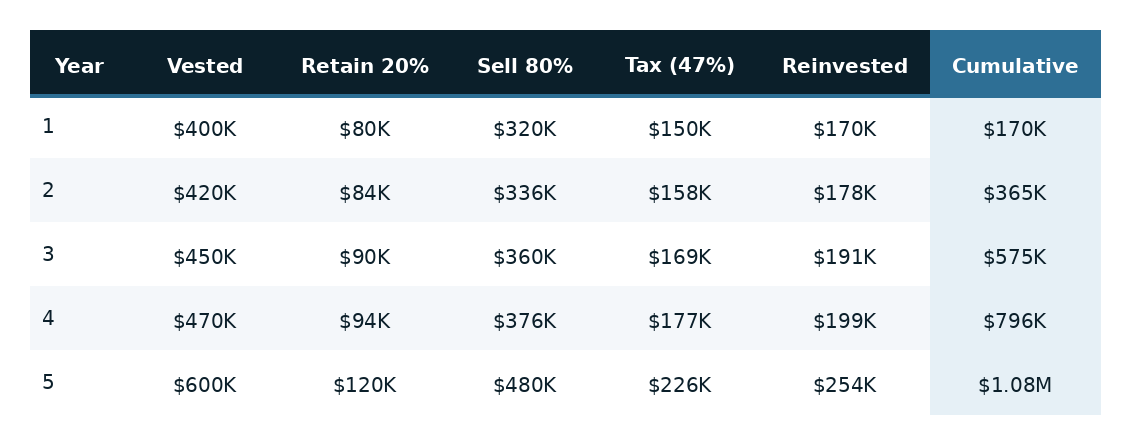
$1.08M reinvested into a diversified portfolio targeting 9% long-term returns:
**✅ In 10 years: ~$2.65M**
**✅ In 15 years: ~$4.2M**
That's the **retirement income engine.**
That's the difference between RSUs that create anxiety and RSUs that create freedom.
## 📊 Real Client. Real Numbers. Real Outcome.
You struggle with your finances even though you make $700K plus.
Meet a client of mine who faced this exact challenge.
### The Starting Point
He was in his early 50s. Sales Director at a major US-listed tech company.
A high performer by any measure.
His income structure:
✔ $250K annual base salary
✔ $250K–$550K annual commissions — variable, performance-driven, never guaranteed
✔ $100K–$200K in RSUs vesting each year
On a good year, total comp north of $1M.
But the commission — nearly triple his base — wasn't always guaranteed.
That uncertainty made every long-term financial decision harder than it needed to be.
He had two goals:
🏡 Leave a legacy for his kids — specifically helping them get into the property market
💰 Retire early on $20K/month in passive income, with genuine financial peace of mind
### What He Had When He Came to Us
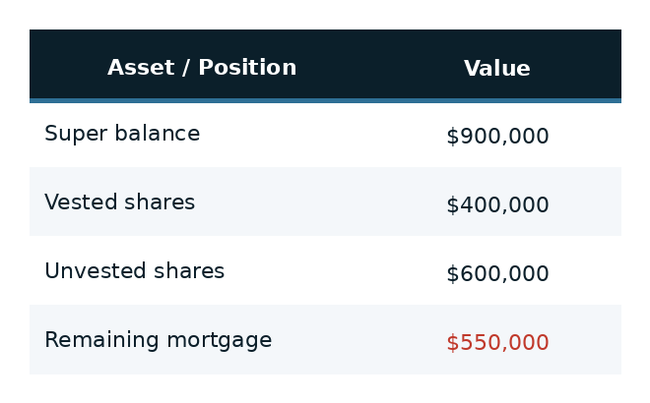
A solid foundation — but no coordinated plan. Every financial decision was made in isolation: a tax return here, a super balance growing untouched there, RSUs vesting and sitting in employer stock by default.
The result? High income. High effort. No compounding momentum.
His role was demanding. Passive income and early retirement weren't a luxury goal — they were an exit plan that needed a structure to make them real.
### What We Did
#### 1️⃣ Made the bonus work as a wealth accelerant, not a spending trigger
His commission — up to $550K in a strong year — was being absorbed by lifestyle and tax without a structured deployment plan. We treated each bonus as a scheduled event with a pre-set allocation:
- Priority 1: Tax provision set aside immediately at marginal rate
- Priority 2: Non-concessional super contribution up to the annual cap
- Priority 3: Mortgage reduction and investment portfolio top-up
- Priority 4: Lifestyle and discretionary spending from what remained
The framework meant he could live comfortably on his base salary alone — and the bonus became a genuine wealth-building event every year it came in.
#### 2️⃣ RSU sell-down and diversification
He held $400K in vested shares — 100% in employer stock. We applied the 33% RSU Rule:
- Sold 67% of vested shares to reduce the mortgage further and improve serviceability
- Redirected proceeds into a diversified portfolio of global funds and Australian shares
- Retained a capped position in employer stock — deliberate, sized, not emotional
- Set up a quarterly sell-down cadence aligned to each vest date going forward
#### 3️⃣ Released $850K in home equity for investment
With the mortgage at $550K and strong property equity, we structured a debt recycling arrangement:
- Released $850K from home equity via an investment line of credit
- Deployed into a diversified portfolio of funds and shares — fully tax-deductible loan interest
- Connected him with a buyer's agent who secured a growth-corridor property in Brisbane
- The investment loan converted non-deductible debt into a wealth-building engine
#### 4️⃣ Super optimisation
With a $900K super balance and a target of $3.5M+ in pension phase, the strategy focused on:
- Non-concessional contributions from RSU proceeds and bonus — up to $120K this FY, rising to $130K next FY
- Investment mix shift to high-growth allocation given the runway to preservation age
- Spouse super contributions to equalise balances and reduce pension phase tax
#### 5️⃣ Legacy and protection planning
Both goals — retirement and legacy for the kids — required structural work beyond investments:
- Updated personal protection plan in the most tax-efficient structure available
- Established a testamentary trust within the will — ensuring assets pass to children in a tax-effective, protected structure
- Modelled multiple scenarios: different housing expenditure levels, investment strategies, retirement dates, and the impact on both goals simultaneously
## The Outcome
⏳ He can retire sooner than he thought.
📈 With more wealth.
🛡️ Less risk.
🎯 And a clear, written path to $20K/month in passive income.
No more ad-hoc decisions. No more vest-day anxiety. No more wondering where the money goes.
He now has a legacy plan for his kids, a coordinated investment strategy, and — for the first time in years — the confidence that his financial position actually matches his income.
**"He told me he feels more in control and far less anxious about his financial future."**
That's what an integrated RSU plan delivers. Not just more money — more certainty.
## Addressing Common Fears
### 📈“What if the stock price goes up after I sell?”
It might. It genuinely might.
But the executives who held everything waiting for the stock to go higher were the same ones calling me in a panic when it dropped 40% — asking what to do now that their net worth had been cut in half.
You are not a hedge fund. You are a human being with a mortgage, a family, and a career that’s already tied to this company.
The 33% RSU Rule isn’t about timing the market. It’s about removing the question entirely. You retain a meaningful position. You redirect the rest. You stop checking the stock price three times a day.
### 🤝“I feel loyal to the company.”
Good. Stay loyal. Do great work. Get promoted. Earn more RSUs.
But loyalty is a relationship between you and your employer — not a financial strategy.
You can be an exceptional employee and a rational wealth manager at the same time. The two are not in conflict.
### ⏱️“I don’t know the right time to sell.”
Neither does anyone else. That’s the honest answer. Market timing is a game that even professional fund managers lose consistently.
What you can control is your process:
- When do my RSUs vest?
- What’s my marginal tax rate this financial year?
- Do I have unused carry-forward concessional contributions I can deploy?
- What percentage should I retain given my existing concentration?
- Where do the proceeds go the day after I sell?
Answer those five questions with a plan — not a guess — and the ‘when’ stops being the hard part.
### 🧾“My accountant handles my tax return. Isn’t that enough?”
Your accountant does exceptional work. And they’re the right person to lodge your ESS statement and calculate your tax liability at year end.
But reactive tax management — handling the damage after the financial year closes — is fundamentally different from proactive RSU strategy.
By the time your accountant sees the numbers, the vest has already happened. The tax has already been assessed. The concentration has already grown.
We work before the vest. That’s where the leverage is.
### 🧠“I’ve been meaning to sort this out for years.”
I hear this constantly. From executives earning $400K. From people who’ve been vesting RSUs for five or six years and still don’t have a plan.
You’re not behind because you’re not smart. You’re behind because no one built this around you specifically — your vesting schedule, your income, your super position, your retirement timeline.
That’s what the [Early Retirement Blueprint](https://www.deltafinancialgroup.com.au/early-retirement-blueprint-offer/) does.
## 💬 What Clients Say
Trusted by senior tech executives across Australia.
> "I was looking for a financial adviser who understands my unique position as a tech professional with an employee share scheme. Mike has helped me understand how to make my money work harder and has provided a tailored approach I really value."
— **Alison Winterflood**, Software Development Manager, Atlassian
> "His service is ideal for time-poor tech executives who want to kick goals. I feel more confident that I can leave a legacy for my kids."
— **Alyssa O’Connell**, Head of Commercial ANZ, Uber
> "Mike quickly put in place a revised retirement plan that involved minimising the fees I was paying in superannuation and having a more structured investment strategy. I now feel a level of confidence and control that my future is heading in the right direction."
— **Karl Pickering**, Solutions Architect, Iron Mountain
> "Mike effortlessly provided a solid plan to build & strengthen our portfolio beyond what we thought was possible. As our knowledge increased, so did our confidence in our decision to choose Delta."
— **Sam Wong**, Senior Project Manager, Versent
## Watch: how the Early Retirement Blueprint works
## Here's What Happens Next
I work with a small number of senior tech executives at a time. I'm not a call centre. I'm not a robo-adviser. I'm a boutique financial adviser who has built 250+ Early Retirement Blueprints for people in exactly your situation.
---
### The 15-Minute RSU Strategy Session
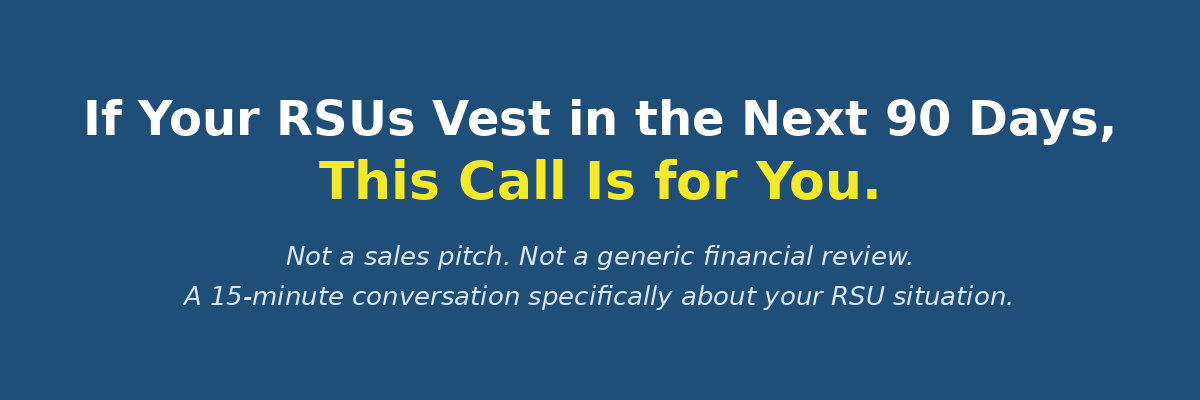
This is not a sales pitch. It's a specific, structured conversation about your RSU position.
In 15 minutes, we'll cover:
- **Your next vest date** — and the exact tax exposure you're looking at this financial year
- **Whether the 30-day window applies** to your situation right now
- **Your concentration position** — how much of your net worth is currently tied to one employer
- **One immediate action** you can take before your next vest to reduce your tax bill or de-risk your position
You'll walk away with clarity — regardless of whether we work together.
---
### Who This Is For
✅ Senior tech exec at Atlassian, Google, Canva, Salesforce, CrowdStrike, or similar
✅ RSUs vesting in the next 90 days
✅ No clear plan for the tax bill, the sell-down, or where the proceeds go after
✅ Household income $400K–$1M+ but not feeling like it
---
### Not Ready to Book? Start Here.
DM me on LinkedIn with the word **RSU** and I'll send you the three questions every tech executive needs to answer before their next vest date. No call required. No obligation.
---
👉 [Learn about the Early Retirement Blueprint](https://deltafinancialgroup.com.au/early-retirement-blueprint-offer)
🌐 [Visit Delta Financial Group](https://deltafinancialgroup.com.au)
📅 [Book your 15-minute RSU strategy session](https://calendly.com/mikesikar/strategysessionwithmikesikar)